

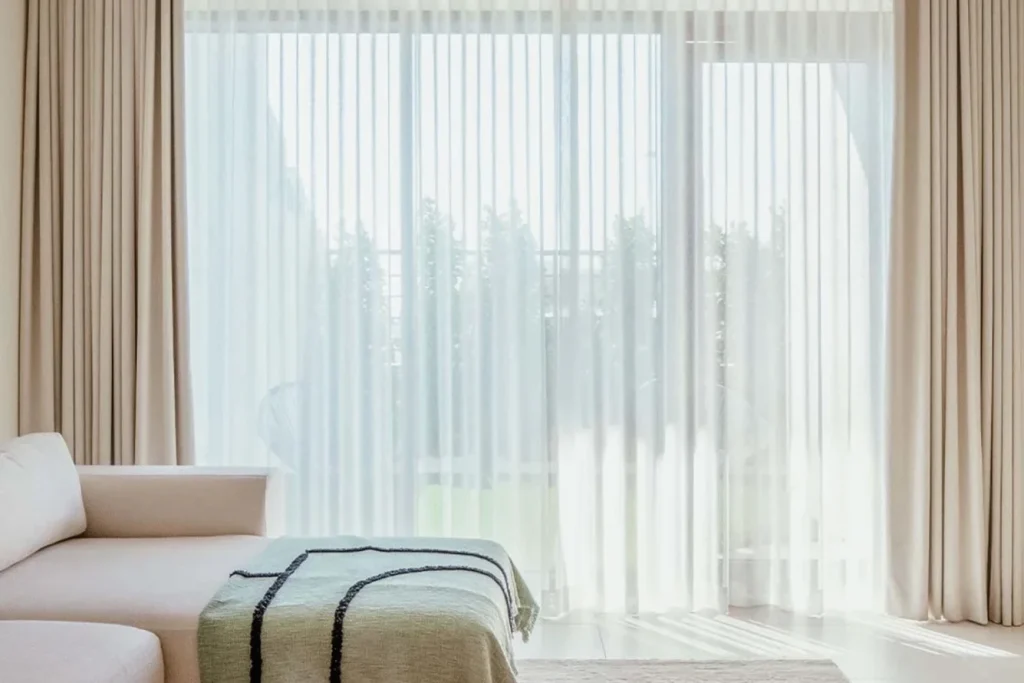
To layer sheer and blackout curtains, hang the sheer on the track closest to the glass and the blackout on a second track in front of it, 6–10 cm apart, so each layer opens on its own. During the day, you draw back the blackout and keep the sheer closed for soft light and privacy. At night, or when the afternoon sun hits, you close both.
That is the whole idea. The rest of this guide covers the details that decide whether it looks like a hotel suite or a curtain that never quite closes: which hardware to use, how to measure for two layers, and what changes for a Dubai apartment that faces west.
Which layer goes in front: sheer or blackout?
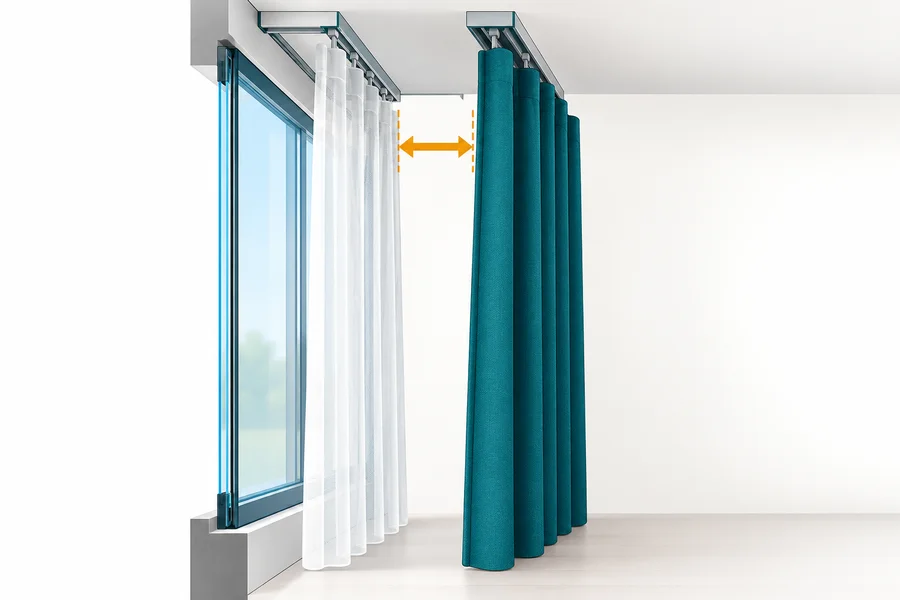
The sheer goes at the back, against the glass. The blackout goes in front, facing the room. This is the standard order for three reasons:
- The blackout seals the window. As the outer layer, it closes over the sheer and covers the gaps around the frame, so less light leaks in at the edges.
- You can use either layer alone. Open the blackout and the sheer stays in place for daytime privacy. Close the blackout and the room goes dark.
- The sheer takes the sun, not the blackout. The layer nearest the glass absorbs most of the UV. A faded sheer is cheaper to replace than a faded blackout.
When to reverse it: put the sheer in front only when the blackout stays closed most of the time and is purely functional — a media room, a nursery, a bedroom for shift workers. The sheer then becomes the window’s decorative face. The trade-offs: the blackout now takes the full sun and fades faster, and opening it by hand means reaching behind the sheer — which is why this order works best on a motorized track.
Which rod or track do you need?
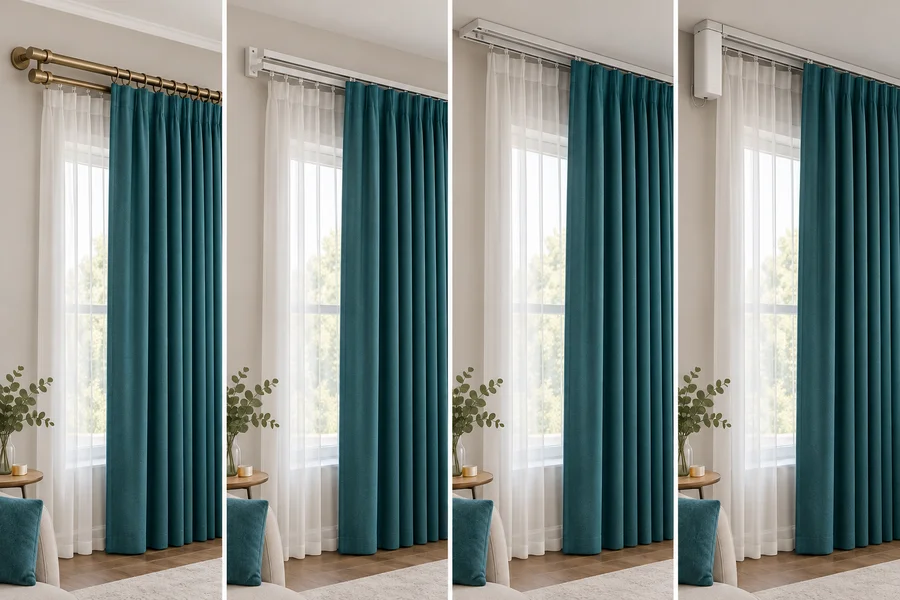
Two layers need two lines of hardware. You have four options, and the right one depends on your window and your ceiling.
Double curtain rod. Two rods on one set of brackets. The simplest choice for a standard bedroom or living room window, and the one to pick if you like a visible rod with finials. It works best with eyelet or ring-top blackout curtains. See our curtain rods.
Wall-mounted double track. Two slim tracks fixed to the wall above the window. The curtains glide on runners, so they open smoothly even when heavy, and they suit pinch pleat or wave headings. A good choice for wide windows where a rod would sag.
Ceiling-mounted double track. The same tracks are fixed to the ceiling or hidden inside a curtain pelmet. This is the cleanest look and the most common setup in Dubai apartments and villas, many of which are built with a recess for it. Mounting at the ceiling also makes the room look taller and stops light escaping over the top.
Motorized double track. Each layer gets its own motor on a ceiling or wall track. One remote, app or voice command opens the blackout while the sheer stays closed. The best choice for floor-to-ceiling glass, double-height windows, and anyone who wants the curtains to move on a schedule — see the motorized section below.
Can you use a single rod? You can hang a sheer and a blackout on one rod, but they will move together and tangle, and you lose the main benefit of layering: controlling each one separately. Treat it as a temporary fix, not a setup.
How to measure for two layers
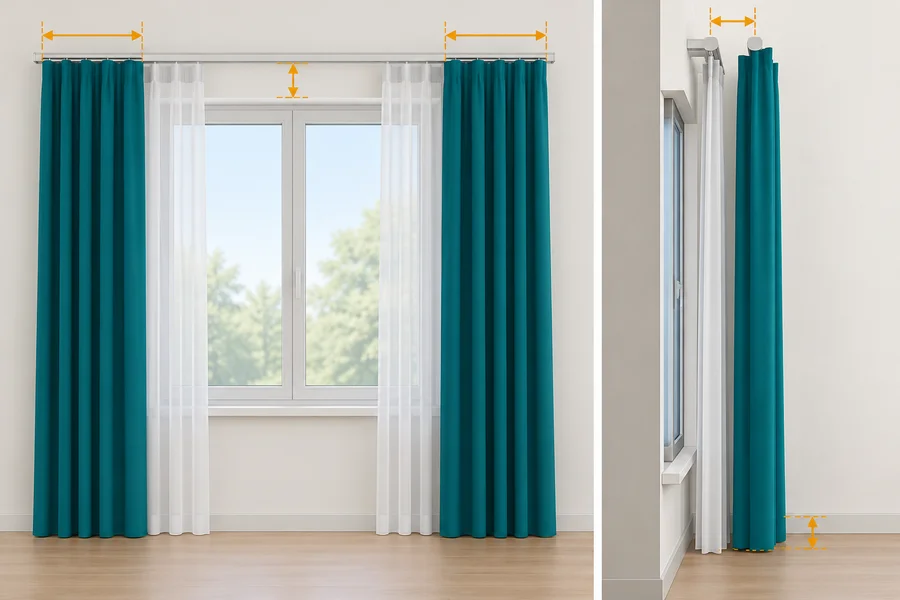
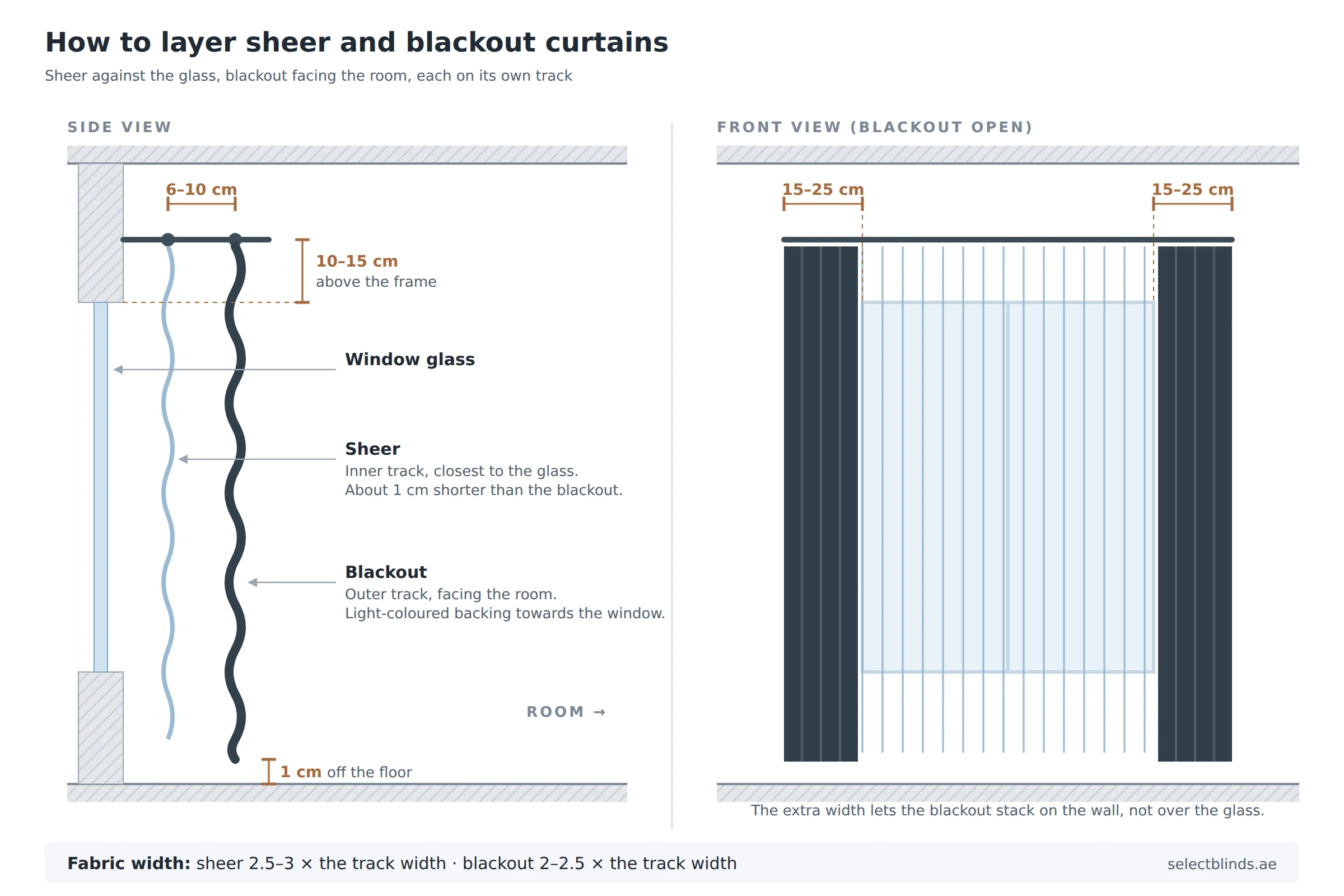
Most layered curtains that look wrong were measured for one layer. Two layers stack wider when open, sit further from the wall, and need more fabric to look full. Use this cheat sheet:
| What to measure | Measurement | Why it matters |
| Track or rod height | 10–15 cm above the window frame, or at the ceiling | Stops light escaping over the top and makes the window look taller |
| Side extension | 15–25 cm past the frame on each side | Two layers stack wider; this keeps them off the glass when open |
| Gap between the two layers | 6–10 cm | Lets the blackout move without dragging the sheer |
| Sheer fullness | 2.5–3 × the track width | Below 2.5 ×, sheers look thin and flat |
| Blackout fullness | 2–2.5 × the track width | Enough folds to close fully without straining |
| Floor-length finish | 1 cm above the floor | Clean line; the hem doesn’t collect dust |
| Sheer vs blackout length | Sheer 1 cm shorter than the blackout | The sheer won’t peek out below the front layer |
Worked example: a 200 cm wide window. Add 20 cm each side and the track is 240 cm. The sheer needs 240 × 2.5 = 600 cm of fabric width; the blackout needs 240 × 2 = 480 cm.
Not sure about your measurements? Our team measures both layers on site and recommends the right track for your window. Book a free home measurement on WhatsApp
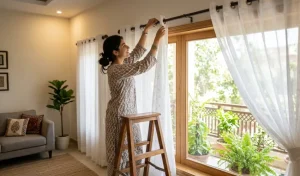
How to hang sheer and blackout curtains: step by step
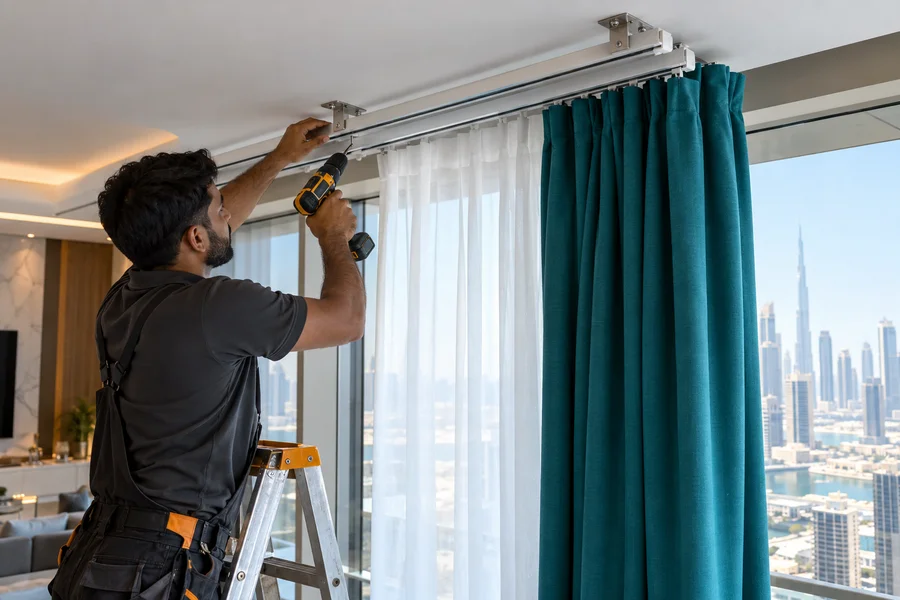
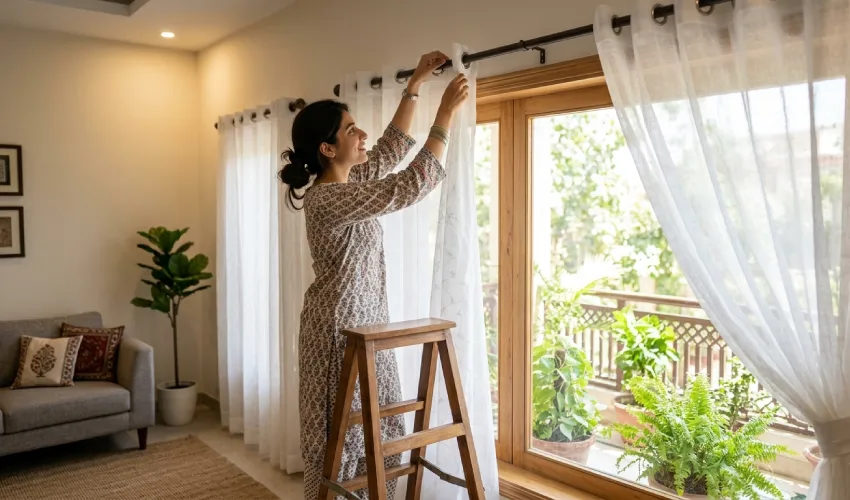
You’ll need a tape measure, pencil, spirit level, drill, wall plugs and screws, a step ladder, and your double rod or track.
- Mark the bracket positions. Measure 10–15 cm above the frame and 15–25 cm past each side. Use the spirit level so both marks sit on one line. On wide windows, add a centre bracket every 120–150 cm so the rod or track doesn’t sag.
- Fix the brackets. Drill, plug, and screw them in. Dubai apartment walls are often concrete or block, so use a masonry bit and proper wall plugs; on gypsum ceilings, fix into the frame behind the board, not the board alone.
- Fit the inner rod or track and hang the sheer. The sheer goes on the line closest to the glass. Spread it evenly across the full width so the folds are the same size.
- Fit the outer rod or track and hang the blackout. Hang it with the lining or coated side facing the window. Check it closes fully in the centre with a small overlap, and that it covers the frame at both sides.
- Train the folds. Close both layers, set the folds by hand, and tie each layer loosely for 24–48 hours. The fabric remembers the shape and hangs straighter after.
- Check for light leaks. Close everything on a bright afternoon and look at the top and sides. Gaps at the sides usually mean the track is too short; light over the top means it’s mounted too low or too far from the wall. Our guide to blocking light leaking from the top and sides of your curtains covers every fix.
Renting and can’t drill? See how to hang curtains without a rod — though for two layers, especially a heavy blackout, a fixed track is far more reliable.
Choosing the fabrics and colors

For the sheer, choose polyester voile or a linen-look polyester. Natural cotton and linen sheers look beautiful, but in strong sun they yellow and weaken faster, and polyester can go in the washing machine. Browse our sheer curtains.
For the blackout, what blocks the light is how the fabric is made, not the fiber:
- Coated blackout has a foam or acrylic backing and blocks the most light. The best choice for bedrooms.
- Triple-weave blackout has a dense black yarn woven into the middle. Softer to the touch, with very little light passing through.
- Lined blackout is any face fabric — velvet, linen-look, jacquard — with a blackout lining sewn behind it. This is how you get a blackout curtain in almost any fabric you like.
A plain velvet or linen curtain is not a blackout curtain unless it is coated or lined. See our blackout curtains.
Color combinations that work:
- Tone on tone — ivory sheer with a sand or taupe blackout. Calm and expensive-looking; the safest choice.
- Light and anchor — white sheer with a charcoal or deep grey blackout. Modern and crisp.
- Color on the front layer only — keep the sheer neutral and let the blackout carry the color or pattern. A patterned sheer over a patterned blackout fights for attention.
By room: bedrooms and nurseries need a coated blackout for real darkness. Living rooms can use a lined or triple-weave blackout, because the sheer does most of the daytime work. Home offices benefit most from the sheer: it cuts screen glare while the room stays bright.
Layering curtains in a Dubai home

Most layering guides are written for cold, grey climates. Dubai has the opposite problem: too much sun, for most of the year. That changes how you use the two layers.
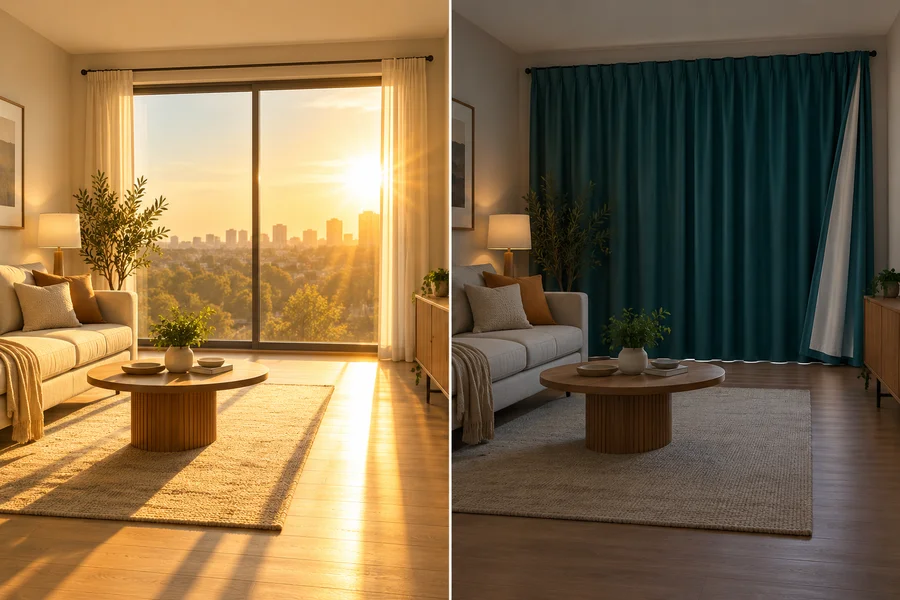
West-facing rooms. The afternoon sun is the hottest and lowest, and it comes straight through the glass. Keep the sheer closed through the day to cut glare, then close the blackout from early afternoon. Stopping the sun before it heats the room means your AC has less work.
Pick a light-backed blackout. The side facing the window should be white or ivory. A light backing reflects sunlight back out; a dark one absorbs it and warms the air behind the curtain. Thermal blackout fabrics add an insulating layer for rooms that get the full afternoon sun.
Floor-to-ceiling glass. Apartments in Dubai Marina, JLT, Downtown, and Business Bay often have floor-to-ceiling glass. Mount a double track on the ceiling so both layers run the full height, and consider motorizing it — pulling 3 meters of blackout by hand every afternoon gets old quickly.
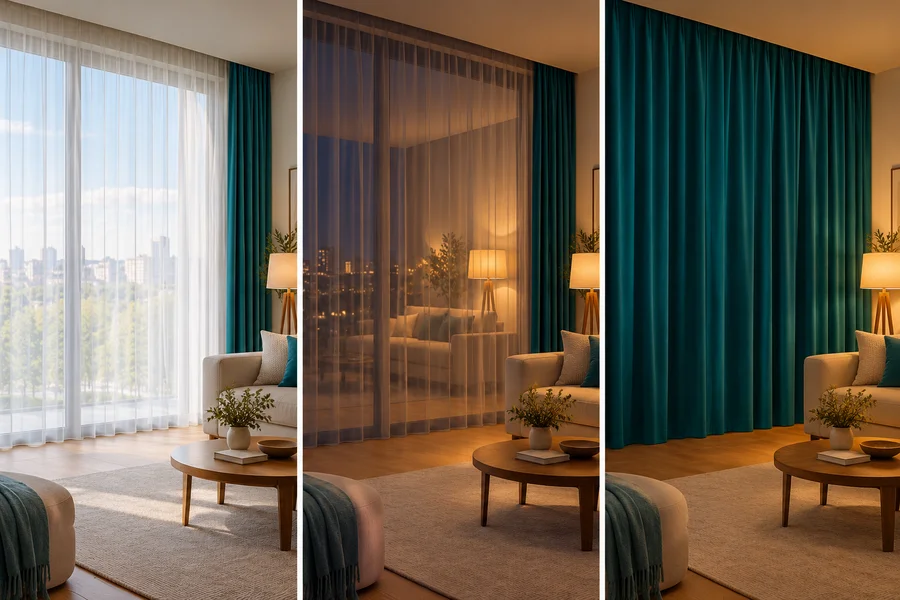
Privacy at night in high-rises. A sheer gives privacy in daylight because it is brighter outside than inside. At night, with your lights on, it reverses, and people can see in. Close the blackout after dark. More on this in: Can you see through sheer curtains at night?
Dust. Sheers next to the glass catch the fine dust that comes in around windows and balcony doors, especially after a sandstorm. Polyester sheers can be machine-washed every two to three months — here is how to wash sheer curtains and how to get the wrinkles out after.
Motorized layered curtains
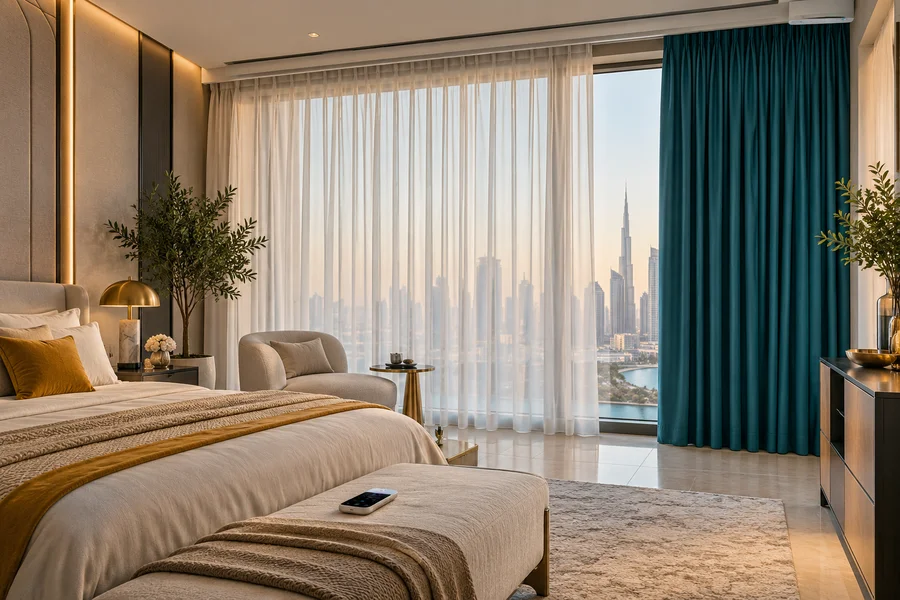
Layering gives you two curtains to manage instead of one. Motorizing them is how you get the benefit without the effort.
On a motorized double track, each layer has its own motor and its own channel on the remote. You can open the blackout and leave the sheer closed, close both at once, or set them to move on their own:
- Morning: the blackout opens at sunrise, the sheer stays closed for privacy.
- Afternoon: the blackout closes before the sun reaches a west-facing window.
- Night: both close at a set time, so the room is never on view.
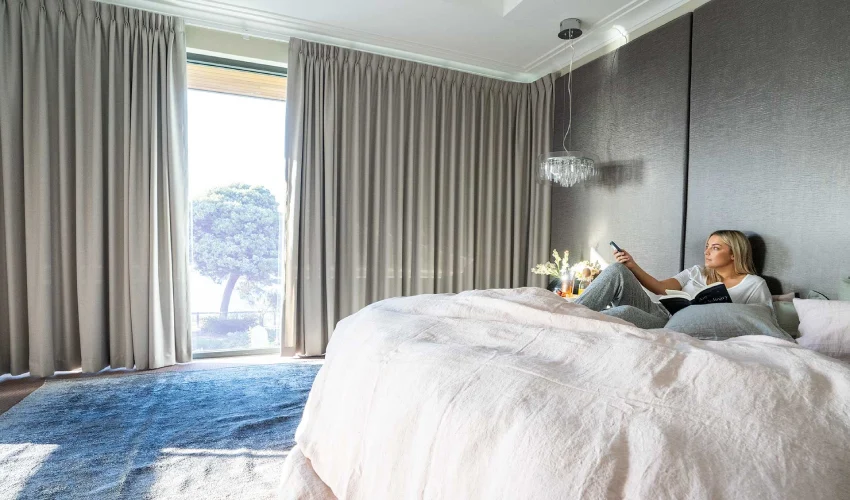
You control them by remote, wall switch, phone app or voice assistant, and from anywhere if the motor connects to Wi-Fi. A motorized track also suits the reversed layer order, because you never have to reach behind the sheer to open the blackout.
Motors run either from a power point near the window or from a rechargeable battery. Read how motorized curtains work, compare options in which motor is best for Dubai homes, or browse our motorized curtains.
Planning floor-to-ceiling or double-height windows? Ask us about a motorized double track for sheer and blackout. Get a quote on WhatsApp
Common mistakes to avoid
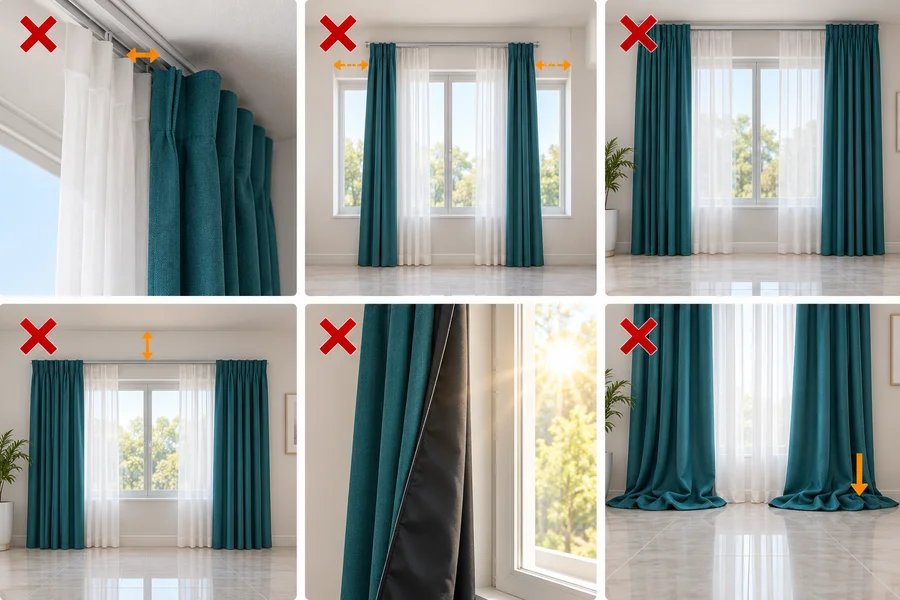
- Measuring for one layer. Two layers stack wider and sit further from the wall. Without the extra side extension, the open curtains cover part of the glass.
- Too little fullness on the sheer. At 1.5 ×, a sheer looks like a flat sheet. Go to 2.5 × or more.
- Hanging the track right on the frame. Light escapes over the top, and the window looks shorter. Go 10–15 cm higher, or to the ceiling.
- Layers too close together. If the gap is under about 6 cm, the blackout drags the sheer open with it.
- Calling any thick curtain “blackout”. Velvet or heavy linen still lets light through unless it is coated or lined.
- A dark lining facing a west window. It absorbs heat instead of reflecting it.
- Puddled hems on tiled floors. They look dramatic in photos but collect dust fast in a Dubai home. Finish 1 cm above the floor.
Frequently asked questions
Which goes in front, sheer or blackout curtains?
The blackout goes in front, facing the room, and the sheer goes behind it, closest to the glass. This lets you open the blackout and keep the sheer closed for daytime privacy, and the front blackout covers the edges better when closed.
Can I hang sheer and blackout curtains on one rod?
You can, but they will move together and tangle, so you lose the ability to use each layer on its own. For a lasting setup, use a double rod or a double track.
How far apart should the two rods or tracks be?
About 6–10 cm. That is enough room for the blackout to open and close without catching the sheer behind it.
How much wider than the window should the track be?
Add 15–25 cm on each side of the frame. Two layers take up more space when open, and the extra width keeps them off the glass.
Should the sheer be the same length as the blackout?
Make the sheer about 1 cm shorter, so it doesn’t show below the hem of the blackout in front.
Can you see through sheer curtains at night?
Yes, when the lights are on inside. Sheers give privacy in daylight only, so close the blackout after dark.
Can layered curtains be motorized?
Yes. A motorized double track gives each layer its own motor, so you can open the blackout and keep the sheer closed from one remote, app, or voice command, or on a timer.
Do layered curtains help keep a room cool in Dubai?
Yes. Closing a light-backed blackout before the afternoon sun reaches the glass keeps heat from building up in the room, so the AC has less to do. A thermal blackout adds extra insulation.
Get your layered curtains made to measure
Layering works when the measurements are right: the right gap between the tracks, enough width to clear the glass, and enough fabric for full folds. Select Blinds measures, makes, and installs sheer and blackout curtains on double rods, ceiling tracks, and motorized tracks across Dubai.
Book a free home measurement. We’ll measure both layers, bring fabric samples, and recommend the right track for your windows. Message us on WhatsApp or call +971 50 293 3585.





)
1 Comment.
[…] Best for: bedrooms and living rooms. Here’s how to layer sheer and blackout curtains. […]