
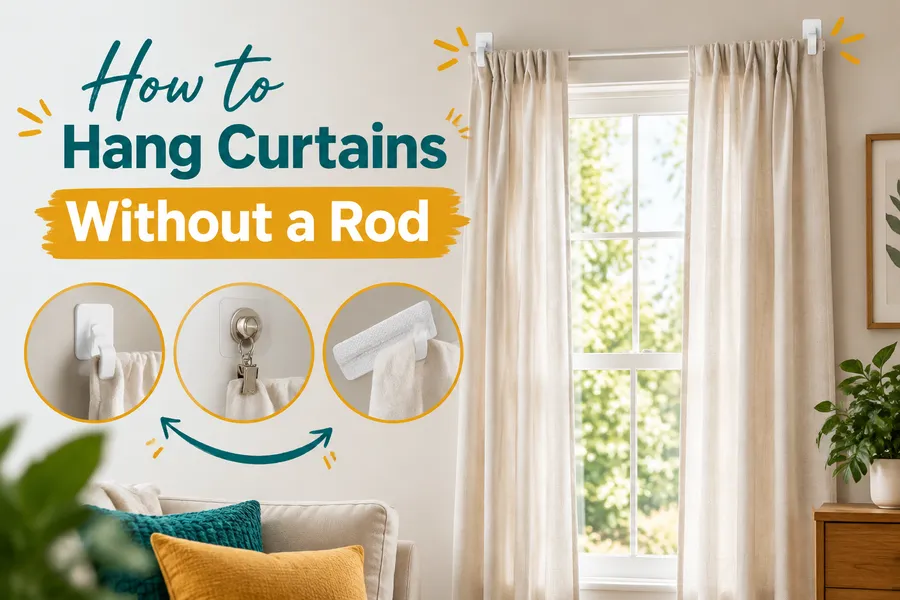
Hanging curtain rods on your room’s wall requires drilling, which means you can’t move the curtain location and you’re left with an imperfect wall. But experts have found a solution: you can hang curtains without a rod and without drilling, but the method depends almost entirely on one thing: how heavy your curtains are. Sheer Curtains will hang from almost anything. Lined blackout curtains will pull adhesive hooks straight off the wall. Work out the weight first, then pick the method.
Weigh Your Curtains First
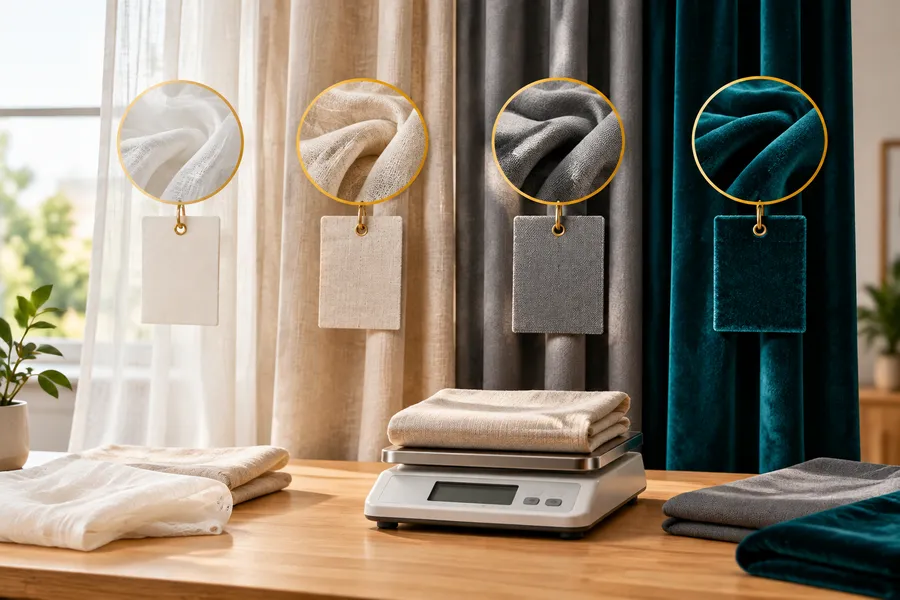
No-drill curtain solutions have weight limits, so estimate the total curtain weight before choosing a fixing method.
Curtain fabric is usually specified by GSM (grams per square meter). To estimate the fabric weight, multiply the total fabric area by the GSM and divide by 1,000.
For example, a 1.5 m wide window with a 2.5 m drop and 2× fullness requires approximately 7.5 m² of fabric for the pair.
| Fabric type | Typical GSM | Approx. fabric weight |
| Sheer, voile, organza | 100–190 | 0.75–1.43 kg |
| Light linen/cotton blend | 200–250 | 1.50–1.88 kg |
| Unlined blackout | 225–280 | 1.69–2.10 kg |
| Medium cotton/chenille | 300–350 | 2.25–2.63 kg |
| Heavy cotton/velvet | 350–400 | 2.63–3.00 kg |
| Jacquard/upholstery weight | 500+ | 3.75 kg+ |
Remember that lining and curtain hardware add to the total load. Lining weight varies by GSM, while hooks, heading tape, rings, and other components add further weight.
For a no-drill installation, compare the complete curtain weight with the manufacturer’s rated capacity for the specific fixing system. Adhesive and hook-and-loop products can have very different load ratings, and their performance also depends on the mounting surface, installation conditions and how the load is applied.
Lightweight sheers are generally easier to accommodate with no-drill systems. Heavier blackout, velvet and upholstery-weight curtains require a fixing system specifically rated for the load.
For large windows and sliding doors, the total weight can increase quickly. For example, a 3 m wide opening at the same 2.5 m drop and 2× fullness requires around 15 m² of fabric, which can result in several kilograms of curtain weight before lining and hardware are added.
The Four Methods That Genuinely Hold
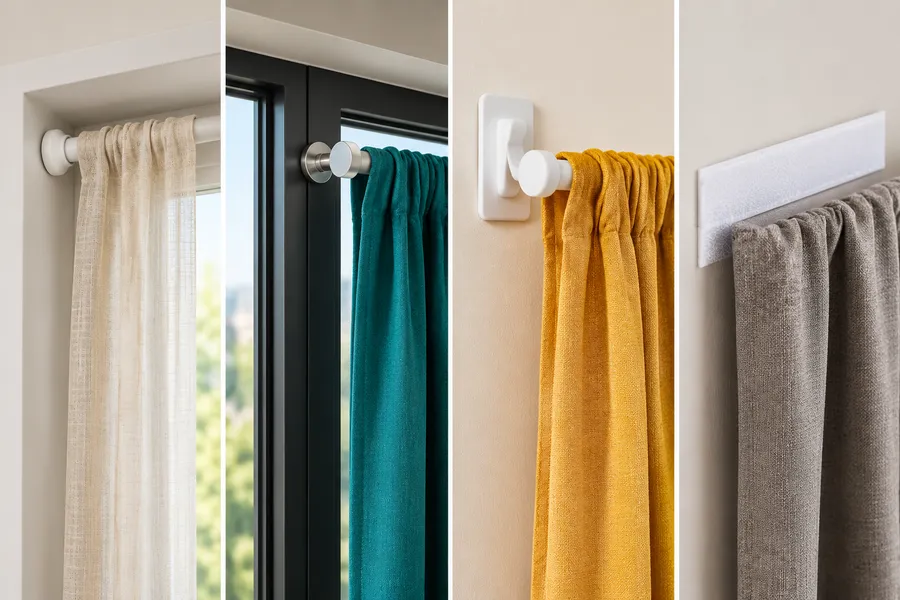
These are the ones worth starting with. All four are reversible, and none need a drill.
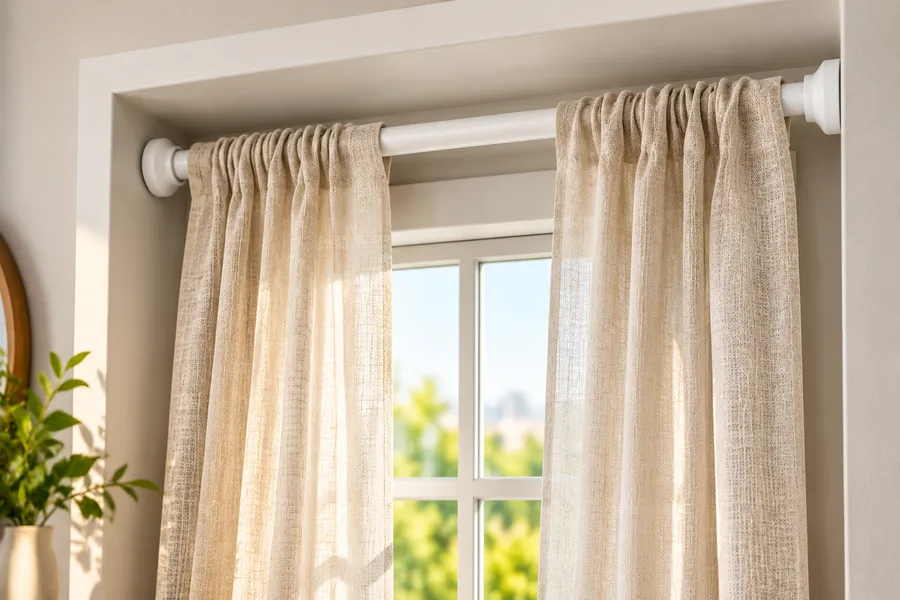
Tension rod. A spring-loaded rod that braces itself between two walls inside a window reveal. No fixings at all, nothing touches the wall surface, and it takes two minutes. Best for recessed windows, and the only method that leaves absolutely no mark. The limits: it needs a reveal deep enough to brace against, it cannot span wider than about 2 m reliably, and it will slip under heavy fabric. Use it for sheers, cafe curtains and light panels.
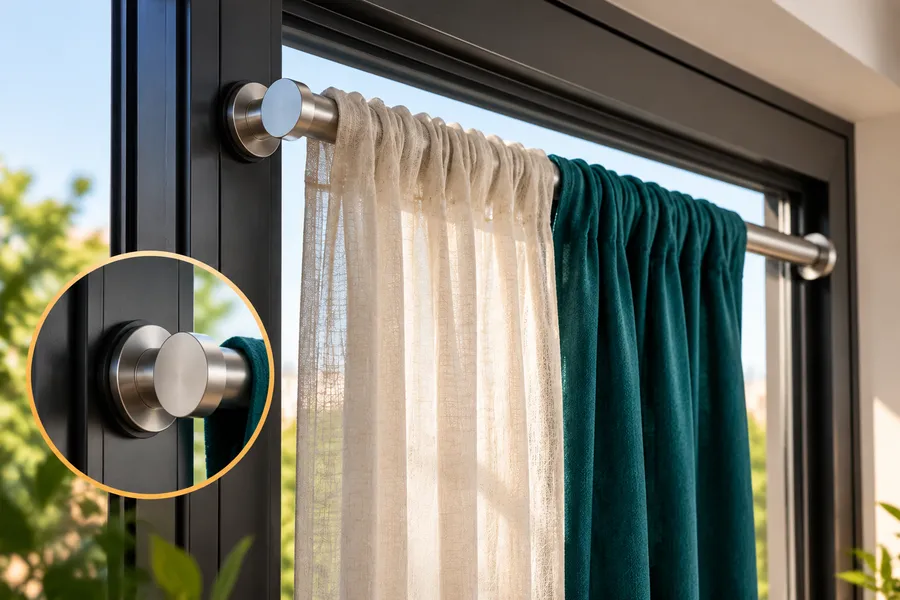
Magnetic rod. A slim rod on magnetic brackets that clamp to a steel surface. If your window frame or door is metal, this is excellent, and it holds more weight than adhesive because the magnet grips a solid surface. Useless on aluminum, uPVC, timber, or plaster, so test with a fridge magnet before buying.
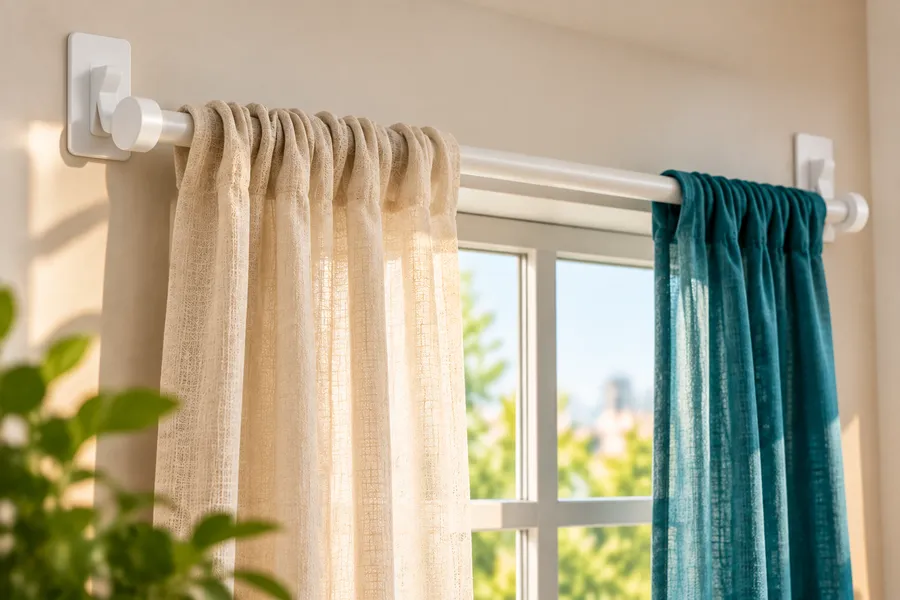
Adhesive hooks. A pair of hooks on either side of the window carrying a light rod or dowel. Cheap, available everywhere, and genuinely reliable within their rating. Failure is almost always down to skipping the surface prep or loading them too soon, which the step-by-step below covers.
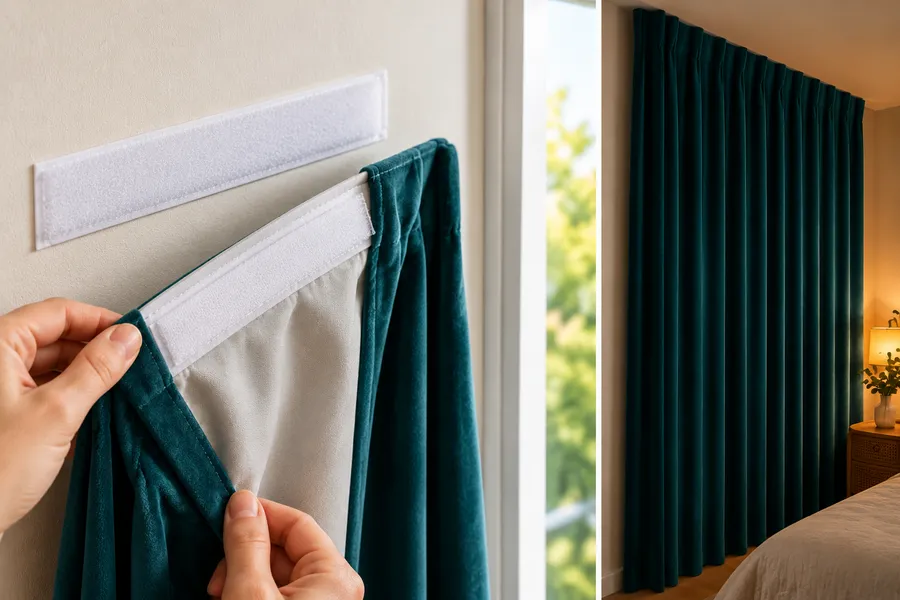
Hook-and-loop strips. Industrial-strength fasteners, one half on the wall and the other sewn or stuck to the curtain header. The curtain hangs flat against the wall with no rod at all, which incidentally closes the light gap at the top. Rated to around 4.5 kg, it needs the wall cleaned with rubbing alcohol and 15 minutes to cure before you hang anything.
That last one has a hidden benefit worth knowing about. Because the fabric sits flush to the wall instead of hanging away from a rod, it blocks considerably more light than a rod-hung curtain ever will.
Decorative Ideas, for Light Curtains Only
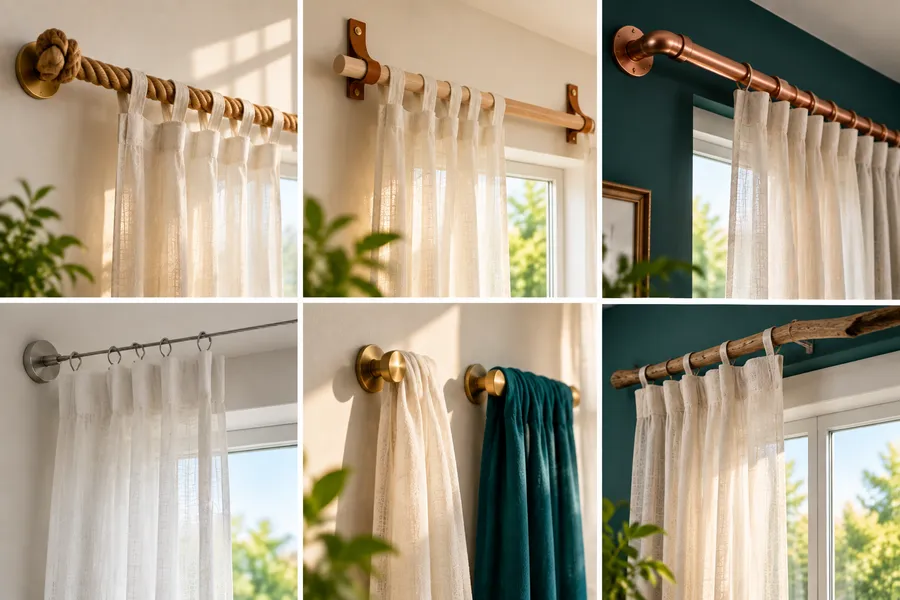
These look good and cost very little, but read the weight table again before you commit. None of them will carry a lined curtain.
Rope or thick cord. Run it between two hooks or brackets and thread the curtain on. Suits coastal, rustic, and boho rooms. Rope stretches and sags over time, so expect to retighten it, and keep the span under about 1.5 m.
Twine or cable wire. A thinner version of the same idea. Steel cable with a turnbuckle holds its tension far better than twine and can span wider. Good for cafe curtains and pantry or kitchen windows.
Wooden dowel. A length of dowel from any hardware shop, resting on two adhesive hooks or cup hooks. It looks like a proper rod at a fraction of the price, and you can stain or paint it to match the room.
Copper or uPVC pipe. Same principle, sturdier, and copper in particular looks deliberate rather than improvised. Pipe handles more weight than dowel and works well across bay windows.
Cabinet knobs or drawer pulls. Fixed either side of the window with the curtain looped or tied over them. This is a design feature rather than a hanging system: it only works with tab-top or tie-top curtains, and the panels stay fixed rather than drawing open and closed.
A tree branch. A genuine look for the right room, and free. Choose one that is straight, fully dry, and stripped of bark, or it will shed and may bring insects indoors. Seal it before hanging.
One honest note on ideas you will see elsewhere. Hanging curtains from sports equipment, plastic toys, or upholstery tacks pushed straight into plaster makes for an eye-catching listicle, but none of it holds a real curtain, and tacks in plaster tear out under load. We have left those out on purpose.
If You Can Make One Small Hole
A single pinhole is often more acceptable to a landlord than a large adhesive patch that peels paint off when you remove it. If you can put in something small, these carry far more weight than any stick-on option.
Cup hooks or screw-in hooks. Two hooks on either side of the window, with a dowel, pipe or cable between them. A hook driven into a timber frame or a plugged wall holds several kilos each, which puts lined curtains back on the table. The hole left behind is a few millimeters and can be filled with a dab of filler.
Finish nails or panel pins. Slim nails into a timber window frame, with the curtain hung on rings or loops. Almost invisible once removed. Only works where there is actual timber to nail into, which rules out most Dubai apartments.
Decorative wall hooks. Ornamental hooks fixed on either side, with the curtain looped over. These become part of the room’s look rather than something to hide.
A note on tacks. Upholstery tacks pushed into plasterboard will pull out under the weight of a curtain. They work in timber, not plaster. If the wall is plaster or concrete, use a hook with a plug instead.
Before drilling anything in a rented apartment, check your tenancy agreement and ask building management. Many Dubai buildings allow small fixings but require you to fill the holes at the end of the tenancy, and some prohibit drilling into concrete ceilings entirely.
How to Fit Adhesive Hooks So They Do Not Fail
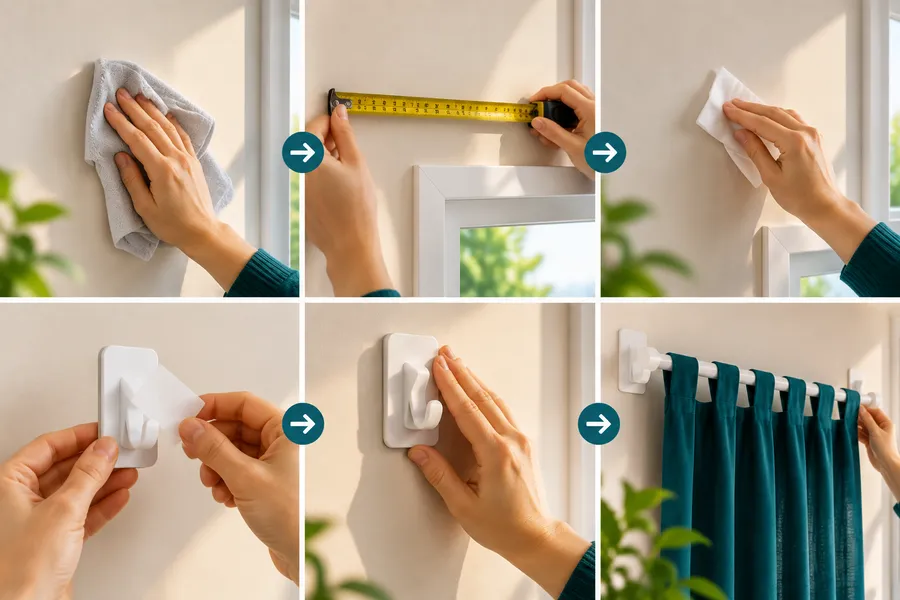
Most adhesive failures are installation failures, not product failures. The strips are rated for a clean, dry, sound surface, and people load them within minutes on a dusty wall.
- Check the wall first. Adhesive needs a solid, smooth, painted surface. It will not hold on textured paint, wallpaper, unsealed plaster, limewash, or anything flaking. Press the surface with your thumb: if paint marks or powders, the adhesive will take the paint off rather than hold.
- Measure and mark both positions. Hold a spirit level or use a phone level app. Once the adhesive is down, you get one chance, and a 5 mm hook shows badly across a 1.5 m span.
- Clean with rubbing alcohol. Not water, not a household spray. Isopropyl alcohol removes the invisible film of dust and oil that causes most failures. Let it dry completely.
- Press firmly for 30 seconds per hook. Real pressure, not a tap. The adhesive needs contact across its whole area.
- Wait before loading. Give the adhesive at least 15 minutes to cure, and an hour is better. This is the step people skip, and it is the most common cause of a curtain on the floor the next morning.
- Hang the rod, then the curtain. Add the fabric last so you can check the rod sits level and the hooks are holding before the full weight goes on.
- Leave it overnight before drawing the curtains. Opening and closing puts sideways load on the hooks, which is harder on adhesive than static weight.
To remove without damage, warm the adhesive with a hairdryer for 30 seconds and pull the release tab slowly, straight down and parallel to the wall. Pulling outward pulls the paint with it.
How High and How Wide to Hang
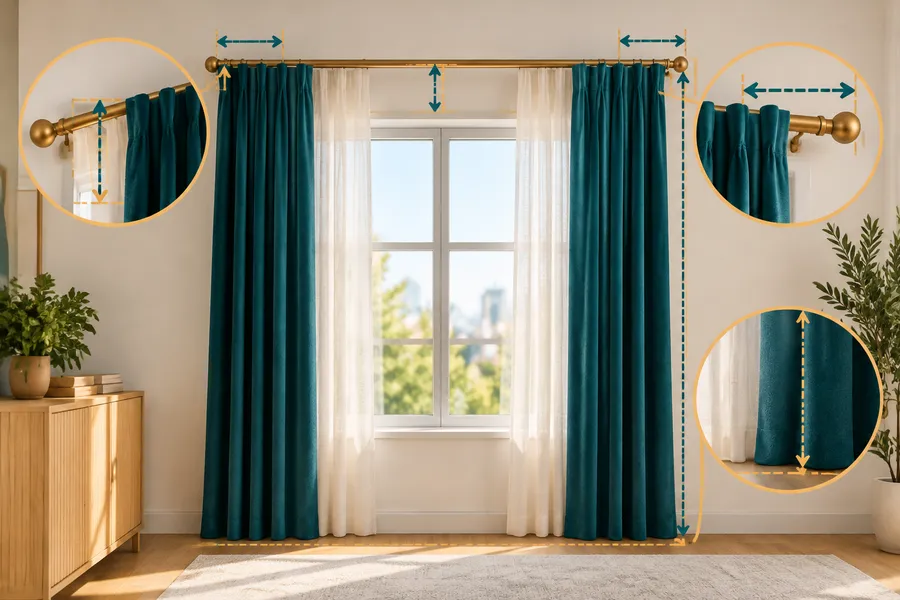
Whether you drill or not, these figures decide whether the result looks deliberate or improvised.
| What | Target | Why |
| Height above the window frame | 15-20 cm | Makes the window read taller and the ceiling higher |
| Width past each side of the frame | 20-25 cm | Lets the curtain stack clear of the glass when open |
| Total fabric width vs rod width | 2 to 2.5 times | Below 2x, the curtain hangs flat instead of gathering |
| Curtain length | Floor, or 1 cm above | Short curtains are the single most common styling mistake |
| Tension rod maximum span | About 2 m | Beyond this, it sags and slips under load |
| Rope or twine maximum span | About 1.5 m | Longer spans sag visibly within weeks |
On a tension rod inside a reveal, you lose the height and width allowances, because the rod has to sit within the opening. Accept that trade-off for the zero-damage benefit, or move to hooks mounted outside the reveal if the look matters more.
One thing worth knowing if light control is part of why you are here: a rod mounted inside the reveal leaks light on all four sides. Mounting outside the reveal blocks considerably more.
What Makes Dubai Different

Almost every article on this topic is written for American or British homes with plasterboard walls and timber window frames. Dubai apartments are built differently, and three things change the answer.
The walls are concrete or block, not plasterboard. You cannot push a tack into them, and a standard wall plug needs a masonry drill bit. This actually pushes more people toward no-drill methods than in other markets, so getting the adhesive right matters more here.
Heat and humidity work against adhesive. Adhesive strips are rated at normal room temperature on a dry surface. A wall that sits in direct afternoon sun, or one in a bathroom or kitchen where humidity swings, will hold less than the rated weight and may release over months rather than years. Fit adhesive on a shaded interior wall where you can, keep the load well under the rating, and expect to re-fit occasionally on a sun-facing wall.
Frames are usually aluminum or uPVC. That rules out magnetic rods, which need steel, and it rules out nailing into timber. Test with a fridge magnet before you buy a magnetic rod, because aluminum looks like steel and holds nothing.
Two more local points. Dubai sun means many people here want blackout fabric, which is exactly the weight class that no-drill methods cannot carry, so read the weight table before ordering. And most tenancy agreements here address fixings: small fillable holes are commonly accepted, drilling into concrete ceilings often is not, and building management approval is worth getting in writing before you start.
When No-Drill Is the Wrong Answer
It is worth being straight about the limits, because a curtain that falls at 3 a.m. costs more than a proper fitting would have.
Skip the no-drill route if any of these apply:
- Your curtains are lined, blackout, velvet or jacquard. Check the weight table. You are over the limit on a small window and far over on a large one.
- The window is wider than about 2 m. Tension rods slip, rope sags, and adhesive hooks can’t carry enough load at that span.
- It is a sliding door or floor-to-ceiling glazing. These need a track, usually ceiling-mounted.
- The wall is textured, wallpapered, or flaking. Adhesive will not bond, and what it does bond to will come off with it.
- You want real darkness. No-drill methods leave gaps at the top and sides by design. If you are here because light is waking you up, sealing the edges is the actual fix, and that needs fitted hardware.
- You will be in the property for years. Two small filled holes cost less than replacing adhesive strips every few months.
If you are in one of those situations, a fitted track is the honest recommendation. A professional installation uses the right fixing for a concrete or block wall, carries any curtain weight, and takes an hour or two per room. We fit tracks and rods across Dubai and can tell you what your windows need from a photo.
Which Method for Your Window
| Your situation | Use this |
| Renting, cannot mark the wall at all | Tension rod inside the reveal |
| Recessed window, light curtains | Tension rod |
| Steel window frame or door | Magnetic rod |
| Aluminum or uPVC frame, no drilling | Adhesive hooks with a dowel |
| Want the curtain flush to the wall | Hook-and-loop strips |
| Light sheers, want a design feature | Rope, cable or cabinet knobs |
| Kitchen or pantry cafe curtain | Steel cable with a turnbuckle |
| Bay window | Copper or uPVC pipe on hooks |
| Can make two small holes | Cup hooks with a dowel or pipe |
| Lined or blackout curtains | Fitted track, not a no-drill method |
| Window wider than 2 m | Fitted track |
| Sliding door or floor-to-ceiling glass | Ceiling-mounted track |
| Need genuine darkness | Fitted track, or a blackout blind with side channels |
If you are between two options, choose by weight. It decides more than the look does.

Not Sure What Your Windows Need?
Send us a photo of the window on WhatsApp and tell us roughly how heavy your curtains are, and we will tell you whether a no-drill method will hold or whether you need a fitted track. If you would rather have it done properly, we measure free across Dubai and fit tracks, rods and blinds the same week.
Frequently Asked Questions
Can You Hang Curtains Without Drilling At All?
Yes. A tension rod braced inside the window reveal needs no fixings whatsoever. Adhesive hooks and hook-and-loop strips also avoid drilling, but they have weight limits that a tension rod inside a reveal does not share.
How Much Weight Can Adhesive Hooks Hold?
It varies by brand and size, and industrial-strength hook-and-loop fasteners are rated to around 4.5 kg. That figure assumes a clean, sound, room-temperature surface. Derate it on a sun-facing wall or in a humid room.
How Heavy Are Curtains, Actually?
For a 1.5 m window with a 2.5 m drop, a pair of sheers weighs under 1.5 kg, unlined blackout around 2 kg, and lined blackout or velvet 3 to 4.5 kg. Add 0.3 to 0.5 kg for hardware. Multiply the fabric area by its GSM to work out your own.
Will A Tension Rod Hold Blackout Curtains?
Usually not. Tension rods rely on friction against the reveal walls, and heavy fabric makes them slip and drop. Use them for sheers and light panels.
Do Adhesive Hooks Damage Paint?
They can, particularly on freshly painted or poorly prepared walls. To remove safely, warm the strip with a hairdryer for about 30 seconds, then pull the release tab slowly straight down against the wall rather than outward.
Why Do My Adhesive Hooks Keep Falling Off?
Almost always one of three things: the wall was not cleaned with rubbing alcohol, the strip was loaded before curing for 15 minutes, or the curtains are heavier than the rating. Heat on a sun-facing wall is a fourth cause in Dubai.
Will A Magnetic Rod Work On My Window?
Only if the frame is steel. Test with a fridge magnet first, because aluminum and uPVC look similar and hold nothing.
Can I Hang Curtains Without A Rod On A Concrete Wall?
Yes, with adhesive fixings, as long as the wall is smooth and painted. Concrete rules out tacks and nails entirely, and drilling needs a masonry bit and plug.
What Can I Use Instead Of A Curtain Rod?
A wooden dowel, copper or uPVC pipe, steel cable with a turnbuckle, rope, or a tension rod. Dowel and pipe look closest to a real rod; cable spans the widest.
How High Should Curtains Hang Without A Rod?
The same as with one: about 15-20 cm above the window frame and 20-25 cm past each side. A tension rod inside the reveal cannot achieve this, which is the trade-off for leaving no marks.
Can I Hang Curtains From The Ceiling Without Drilling?
Not reliably. Ceiling fixings carry the full weight in shear, and adhesive is not suited to it. Ceiling tracks need proper fixings, and in Dubai many buildings restrict drilling into concrete ceilings, so check with building management.
Will No-Drill Curtains Block Light Properly?
They reduce it but won’t block light completely, because gaps remain at the top and sides. Hook-and-loop strips do better than most because the fabric sits flush to the wall. For real darkness, you need sealed edges, which means fitted hardware.

1 Comment.
[…] and can’t drill? Seehow to hang curtains without a rod — though for two layers, especially a heavy blackout, a fixed track is far more […]